Flockhill Lodge: what to know before you go
A working high-country station of 14,500 hectares, 90 minutes from Christchurch, on Robb Report's 50 Greatest Luxury Hotels on Earth three years running and TIME's World's Greatest Places 2026. What it is, where it sits, and how we build it into a South Island journey.
Lodge Insider·Wild Interior·6 min read·
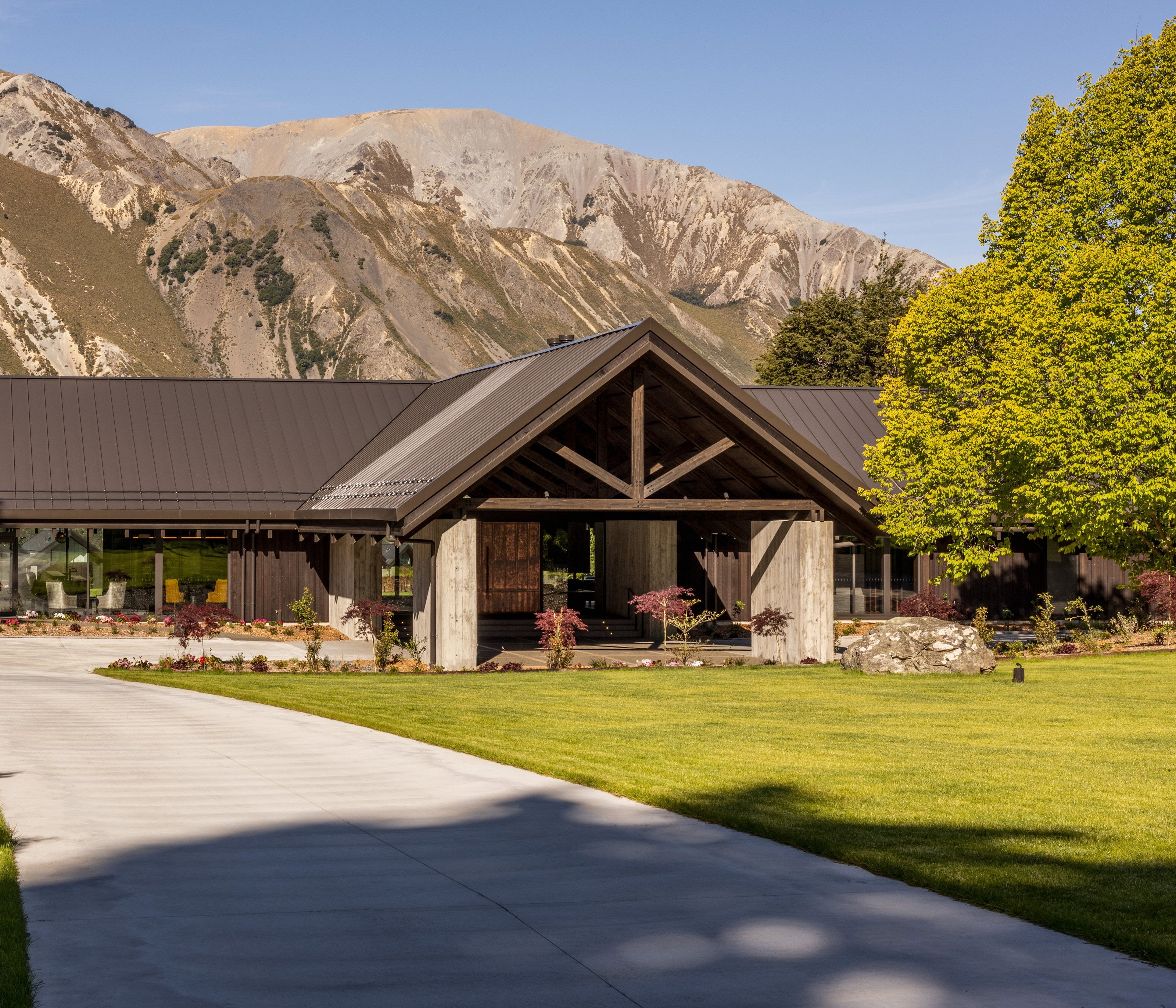
There is a point on the road over Porters Pass, about an hour out of Christchurch, where the plains fall away behind you and the road drops into a wide basin of tussock and limestone with almost nothing built in it. Flockhill is on the far side of that view. It is a working sheep station of 14,500 hectares (36,000 acres) in the Craigieburn Valley, 90 minutes from the airport, and it has been on Robb Report's 50 Greatest Luxury Hotels on Earth every year since 2024, ranked third in the world that first year. In March 2026 TIME added it to its World's Greatest Places. This is what it is, where it sits, and how we would build it into a South Island journey.
Why is Flockhill on Robb Report's list?
Robb Report is an American magazine, and its list is chosen by people who book travel rather than write about it. Each year the editors ask 24 leading travel advisors to vouch for five newer properties they regularly recommend, alongside old favourites. The ten named most often are ranked. The other forty are grouped by region. Nobody keeps a place without being vouched for again.
- 2024: Third in the world, behind Claridge's in London and La Mamounia in Marrakesh.
- 2025: Eighth, and the only New Zealand property on the list.
- 2026: In the Australia and Pacific section, published 23 July 2026, alongside Roki Collection Queenstown, the year's other New Zealand entry.
The advisor who put it there in 2024 called the limestone of Kura Tāwhiti next door the clincher, and the magazine's write-up still opens with the land: the acreage, the station, the rock. We think that is the right way round. The buildings at Flockhill are very good. They are the least of it.
Where is Flockhill?
The station sits in the Waimakariri Basin, a high bowl between the Torlesse Range and the Craigieburn Range, on the road between Christchurch and Arthur's Pass. From the airport or the city it is about 90 minutes: across the plains, over Porters Pass, and down into country that changes from farmland to tussock to grey limestone in the space of a few kilometres. Arthur's Pass is 25 minutes further on. Craigieburn Forest Park, next door, climbs through beech forest to peaks above 2,300 metres (7,500 ft).
Most guests drive, or are driven, and the drive is part of the point. Some fly in by helicopter from Christchurch. The TranzAlpine train from Christchurch to Greymouth runs through the basin too, and arriving by rail and leaving by road is a good way to see the pass twice.
What is the station?
The land was taken up in 1857 by Joseph Hawdon, an Australian settler. A coach road came through in 1865, and the barn where the horses were changed is now the lodge's activity centre. In 1917 James Milliken IV named the place Flock Hill for the limestone scattered above Cave Stream, which from a distance looks exactly like a flock of sheep on a hillside. Once you have seen it you cannot unsee it.
Today the station runs around 10,500 sheep and 400 cattle, worked by a small team of shepherds and their dogs. Every stay includes the Farm Tour, which puts you alongside them for a muster, and if you do one thing there, do that. Lambing runs from October to mid-December in the limestone country, and in those weeks the guides walk you somewhere else.
Where do you stay?
- The Homestead. Opened in 2022, designed by Warren and Mahoney. Four bedrooms, five bathrooms, up to eight guests, one party at a time. A private chef and attendant, a wine cellar, a terrace with a pool, hot spa and fire pit, and a view from every room across Lake Pearson to Sugarloaf.
- The Villas. Opened December 2024. Seven villas, each two king rooms joined by a lounge, so a villa can be taken as one suite, a suite with the lounge, or whole for a family or two couples. Fourteen suites in all, each with a fire, a private deck and underfloor heating.
Villa stays include all meals at Sugarloaf and the Farm Tour. The Homestead comes with its own chef throughout, with the option of dining at Sugarloaf. Either way the lodge is small enough that you will rarely see another guest unless you want to.
What is Sugarloaf?
Sugarloaf is the restaurant that opened with the villas in December 2024, and it is the reason people from Christchurch now drive 90 minutes for lunch. It is an open kitchen built around fire, led by Taylor Cullen, a New Zealand chef who trained in Europe and cooked in Sydney before coming home. There is no menu on the table. You are given a seasonal tasting menu with a wine pairing, and most of what is on the plate grew within sight of the building.
In its first growing season around 70 per cent of the produce served came from the Flockhill garden, with glasshouses stretching the season past what the altitude would otherwise allow. The lamb is the station's own, the beef is from the neighbours, and the fish is spear-caught. In winter, when the garden goes quiet, the kitchen cooks from a store of preserves and ferments laid down through the summer, and that is when the food is most interesting. Expect things you have not tasted before, served without fuss.
The Chef's Table, a seat at the fire with the cooks, is kept for lodge guests and sells out. Ask for it when the stay is confirmed, not on arrival. Sugarloaf itself is open to the public Friday to Sunday. A spa followed the restaurant: a gym, a yoga studio, treatment rooms, and an outdoor cedar sauna, cold plunge and hot pool open to the mountains.
What do you do there?
Kura Tāwhiti. The limestone outcrops that maps call Castle Hill stand beside the highway a few minutes from the lodge, and Flockhill's own boulder country runs up to meet them. The Department of Conservation records the site as one of great cultural significance to Ngāi Tahu, who hold it under formal protection. The name means the treasure from a distant land, for the kūmara once grown here. Go in the late afternoon, when the light comes in low and the rock turns from grey to gold, and walk among the stones as Ngāi Tahu ask, on foot and without climbing them. Half an hour there explains the whole valley. The lodge's guides will take you through its own limestone at any pace, up to a full-day walk of around four hours.
Cave Stream. A conservation reserve on the station boundary, where a stream runs into a limestone hill and comes out the other side. The walk around the outside suits everyone. The cave itself is an hour's wade upstream in the dark, calf to waist deep, ending at a waterfall with iron rungs to climb out. The lodge books it and kits you out. Decide on it before you arrive, not after lunch.
The station. A half-day tour by vehicle, with short walks at the viewpoints, is the way to grasp the scale of the place, and it suits guests who would rather not hike. A longer tour goes to the far boundary for lunch and can end with a helicopter home.
Fly fishing. The station's rivers hold brown and rainbow trout, and the lodge says plainly that they are for anglers who already know the craft. Guides book out months ahead, so this is arranged when the journey is.
By air. Flights leave from the lodge: a short flight over the station, a half-day over the glaciers, or a full day to Aoraki / Mount Cook with a guided walk on the Tasman Glacier, a picnic from the Sugarloaf kitchen, and a ski-plane across the West Coast glaciers landing on snow before the flight home.
The night sky. The basin is far from any town, and on a clear night the Milky Way is directly overhead. Ask and a telescope is put in your room after dinner. Winter, with its long nights, is the season for it.
How do we build Flockhill into a journey?
Flockhill is the first stop out of Christchurch, and it changes the shape of a South Island journey. Ninety minutes from the airport, it puts you in the mountains on the first evening rather than the third, and gives the flight from the United States somewhere quiet to wear off.
Two nights is the minimum that makes sense: one for the station and the Farm Tour, one for Kura Tāwhiti and Cave Stream. Three opens the fishing, a flight to the glaciers, and an afternoon at the spa with nothing planned after it. From Flockhill the road carries on over Arthur's Pass to the West Coast, the glaciers, and the Haast Pass road to Wānaka and Queenstown. The inland route turns south to the Mackenzie Basin and Aoraki instead. Either is three to five days done properly. A journey built along the lines of The Southern Heart, or the southern half of The Discovery, takes Flockhill in its first two nights without changing anything else.
Summer brings the garden at full strength and long, slow evenings. Autumn turns the beech and the poplars along the highway to copper. Winter brings the clearest skies and heli-skiing in the ranges next door. Our month-by-month guide covers the rest of the country.
Robb Report's advisors have vouched for Flockhill three years running, and TIME has added its name. The recognition is welcome, and it is also beside the point. The station was here in 1857. The rocks were here a great deal longer. A lodge that lets you feel that, and then serves lamb from the paddock outside the window, was always going to be noticed. We would send you there for the quiet.
Written by
The people who compose the journeys. By PPG Tours, New Zealand owned for more than twenty years. How we write
Places in this piece
Add Curated Experiences as a preferred source on Google (opens in a new tab)
More reading
Lodge Insider