Why we always add a night on Milford Sound
Most visitors to Milford Sound arrive by bus, spend two hours on a cruise, and leave. There is another way — and it changes everything.
Wild Interior·The CE Way·5 min read··Updated
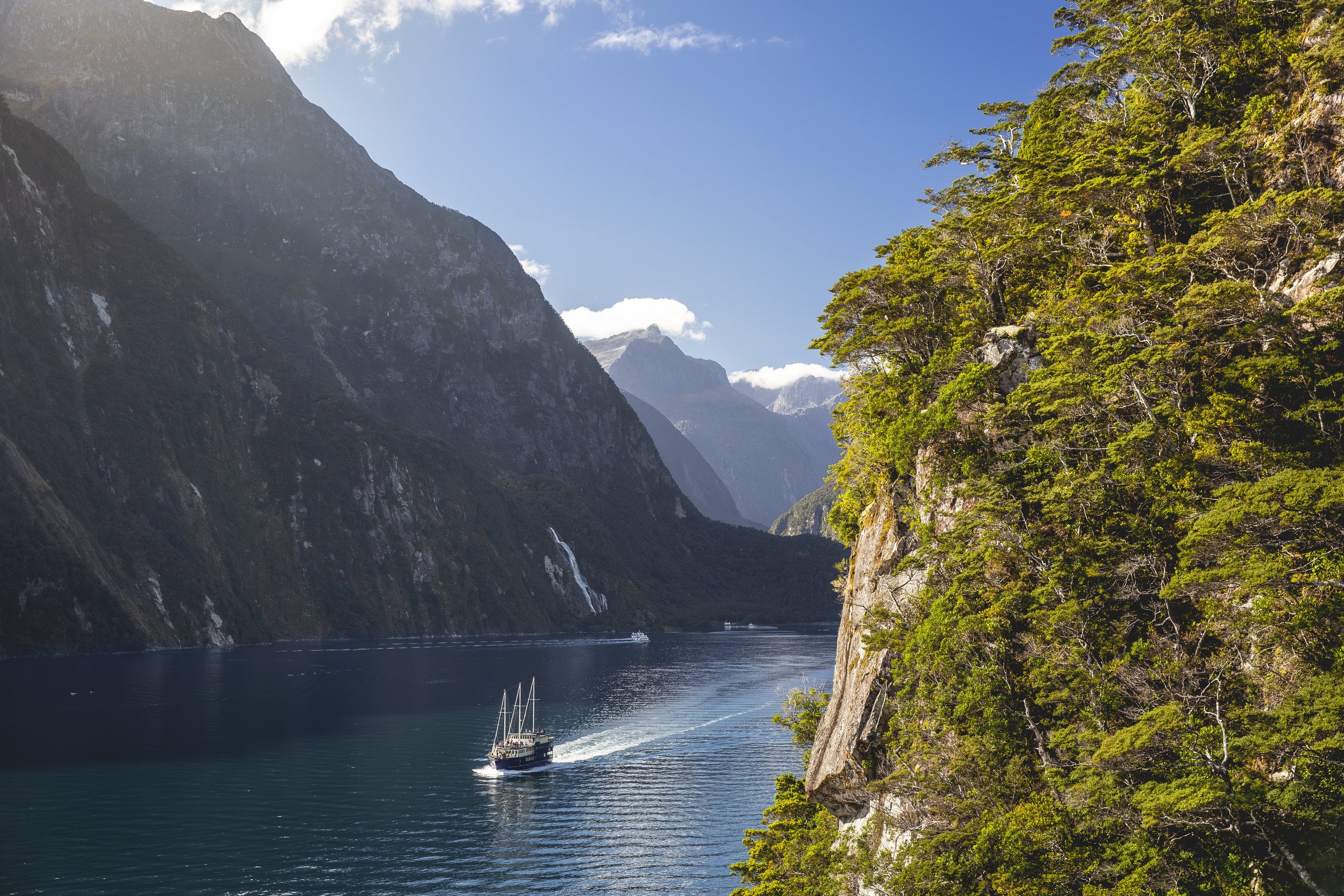
There is a version of Milford Sound that almost no one sees.
It exists after 4pm, when the last of the day-cruise boats turns around and heads back up the fiord toward the wharf. When the wake settles and the water goes still. When the dolphins that spent the afternoon keeping their distance from engine noise come back to the surface. When Mitre Peak — that 1,692-metre granite tower that doubles itself in the water — finally gets to reflect in silence.
We've added an overnight stay on Milford Sound to almost every journey we design that passes through Fiordland. Not as a luxury upgrade. As the correct way to experience it.
What changes when you stay
The day boats carry between 200 and 500 people. The overnight vessels carry between 10 and 80. That alone changes the quality of the experience — but it's what happens between dusk and dawn that matters most.
After the day traffic clears, the fiord becomes a different place. Fiordland crested penguins return to the rocks along the shore. Bottlenose dolphins move through the kelp forests near the cliff bases. The waterfalls — there are over 100 of them, fed by the wettest inhabited place in New Zealand — fall without competition for your attention.
At dawn, before the first morning cruise departs from the wharf, you're on the water with almost no one else. Mist sits low on the surface. The light comes slowly. On clear mornings, the reflection of the fiord walls in the water is so precise it's disorienting — you lose track of where the stone ends and the sky begins.
The Fiordland context matters
Milford Sound — Piopiotahi in te reo Māori — isn't just a scenic highlight. It's the end result of 30 million years of geological work, the last 15,000 of which were spent by glaciers carving the valleys you're sailing through. The rainforest on the valley walls has been growing, largely undisturbed, for thousands of years.
Fiordland National Park is 1.2 million hectares of World Heritage wilderness — the largest remaining tract of temperate rainforest in the Southern Hemisphere. The kind of place that has earned its own silence. Which is exactly why it rewards the people who give it time.
How we build it into a journey
We typically design two nights in the Fiordland region: one night in Te Anau — a small, genuine town on the lake that serves as the gateway — and one overnight on the fiord itself.
Some guests add a third night to walk the first section of the Milford Track, one of New Zealand's nine Great Walks. The track begins in the mountains above the sound and descends through the valley in stages, passing through ancient beech forest. You don't need to walk the full four days. Even half a day at the valley head, where the Clinton River begins, is extraordinary.
If you're interested, I'd love to talk through the options. The right combination depends on how you like to move through a place — and we've done this enough times to know what works for different kinds of travellers.
A word on Doubtful Sound
While we're in Fiordland: Doubtful Sound is Milford's quieter, wilder sibling. Three times the size. No road access — you reach it by boat across Lake Manapouri, then a bus over Wilmot Pass. Resident bottlenose dolphins year-round. Almost no foot traffic.
We sometimes suggest both, when time allows. They're different experiences that don't compete — Milford is dramatic and vertical, Doubtful is vast and still. Together they give you the full range of what this landscape is capable of.
Written by
The people who compose the journeys. By PPG Tours, New Zealand owned for more than twenty years. How we write
Journeys this piece touches
Places in this piece
Add Curated Experiences as a preferred source on Google (opens in a new tab)
More reading
Wild Interior