The Volcanic Plateau: New Zealand's geothermal heart
Nowhere else on Earth combines geothermal wonder, Māori culture, and volcanic landscapes quite like the central North Island. Here is what it feels like to move through it.
Wild Interior·Māori Culture·7 min read·
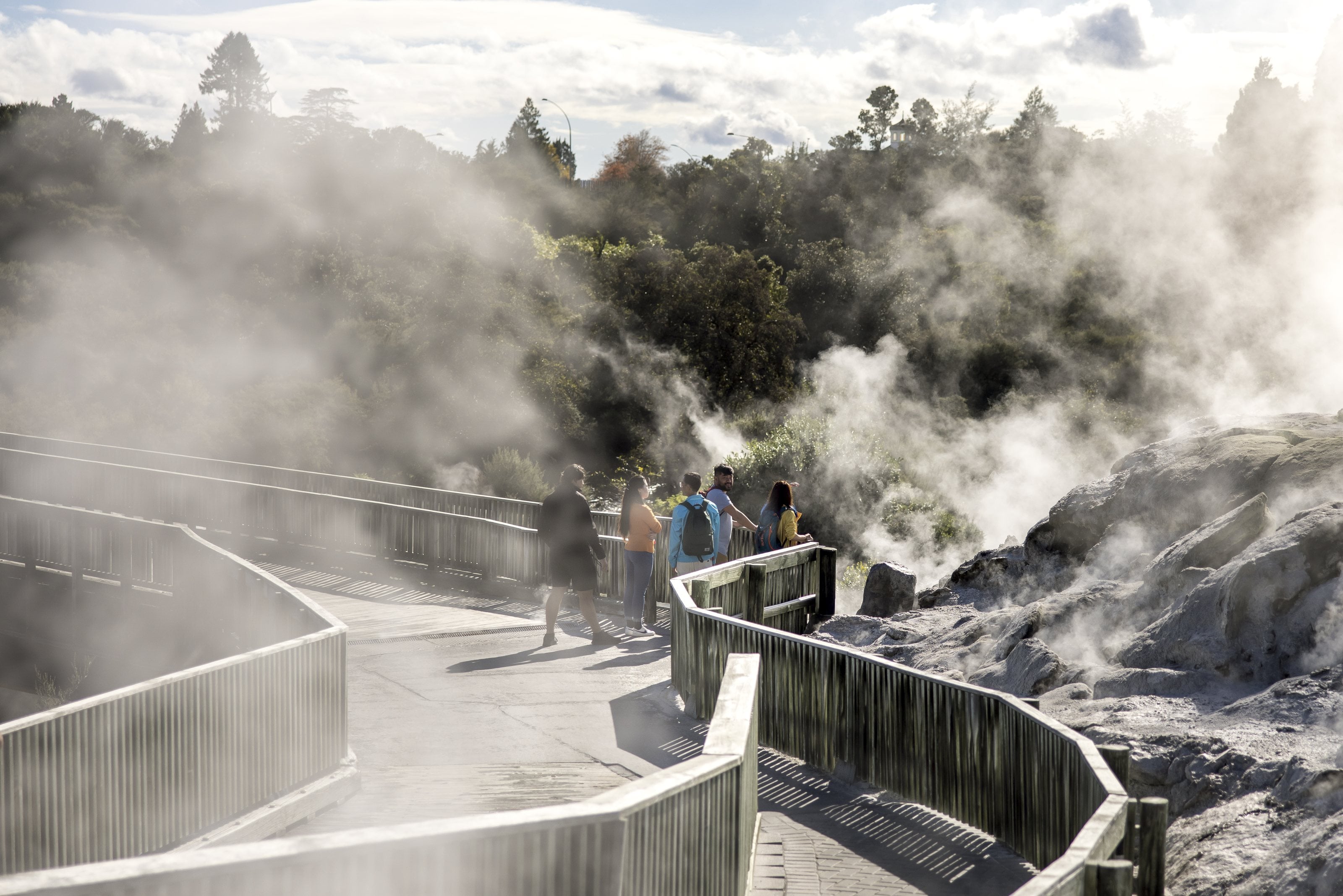
You smell Rotorua before you see it. The sulphur rises from vents in the ground, from boiling mud pools, from steam that escapes through cracks in suburban footpaths. It is not unpleasant — more like the earth is breathing — but it is unmistakable. You are standing on a live geothermal system, and the planet is letting you know.
The Volcanic Plateau of the central North Island is one of the most geologically active landscapes on Earth. It is a UNESCO World Heritage area, a place where the forces that shaped New Zealand are still visibly at work. For visitors, it offers something genuinely rare: a landscape that is not just beautiful but alive.
Rotorua: where the earth speaks
Rotorua sits on the southern shore of Lake Rotorua, in a caldera formed by an ancient volcanic eruption. The geothermal activity here is not concentrated in a single park — it is everywhere. Steam rises from drains. Hot water runs through household pipes. Māori families in Whakarewarewa village still cook in the thermal waters, bathe in them, and use them for heating, just as their ancestors have for generations.
Te Puia, in the Whakarewarewa Valley, is the essential starting point. The Pōhutu Geyser erupts up to twenty times a day, reaching thirty metres — it is the largest active geyser in the Southern Hemisphere. But Te Puia is also home to the New Zealand Māori Arts and Crafts Institute, where carvers work pounamu, bone, and wood, and weavers practise traditional techniques. The combination — geothermal power and living culture in the same valley — is what makes Rotorua unlike any thermal area elsewhere in the world.
A short drive south, Wai-O-Tapu Thermal Wonderland is the most visually surreal landscape in New Zealand. The Champagne Pool, with its vivid orange rim and steaming turquoise water, looks like a painting. The Artist's Palette, a series of coloured pools in yellow, green, and rust, changes hue with the weather and the water level. The Lady Knox Geyser erupts daily at 10:15 — induced, pragmatically, by a biodegradable surfactant that breaks the surface tension.
Waimangu Volcanic Valley, further south again, is the world's youngest geothermal system, created by the 1886 eruption of Mount Tarawera. You walk downhill through a valley of steaming crater lakes — Inferno Crater, Frying Pan Lake, the bird-shaped Cathedral Rocks — and emerge at Lake Rotomahana. It is a walk through geology as recent history, and the silence in the valley, broken only by steam vents and birdsong, is one of the quietest experiences in New Zealand.
For guests who want to immerse themselves, the Polynesian Spa and Hells Gate both offer natural thermal bathing. The Polynesian Spa overlooks Lake Rotorua and has pools ranging from warm to hot, fed by two different springs. Hells Gate, more rugged, combines mud bathing with sulphur spa treatments in a landscape that Māori have used for healing for centuries.
Taupō: the supervolcano lake
An hour south of Rotorua, Lake Taupō fills the caldera of a supervolcano that last erupted around the year 230 — an event recorded in Chinese and Roman chronicles as a reddening of the sky. The lake is the size of Singapore. On a clear day, you can see the three volcanoes of Tongariro National Park — Tongariro, Ngāuruhoe, and Ruapehu — rising across the water to the south.
The Waikato River, New Zealand's longest, flows out of the lake and almost immediately narrows into Huka Falls — a churning turquoise cascade that carries 220,000 litres of water per second through a cleft in the rock. A footbridge crosses just above the falls. You stand there and feel the volume of water through your feet before you fully register what you are looking at.
Taupō is also the location of Huka Lodge, New Zealand's original luxury lodge, set on seventeen acres of riverside grounds. For guests staying there, the geothermal experiences of the central plateau are part of the daily rhythm — a morning at Wairakei Geothermal Park or the Craters of the Moon steam field, an afternoon on the lake, an evening in the lodge's riverside dining room with the sound of the Waikato moving past the windows.
Tongariro: the crossing
Two hours south of Taupō, Tongariro National Park is a dual UNESCO World Heritage site — recognised for both its natural and cultural significance. The three volcanoes at its heart — Tongariro, Ngāuruhoe, and Ruapehu — are sacred to Ngāti Tūwharetoa, the local iwi. Ngāuruhoe, the youngest and most perfectly conical of the three, served as Mount Doom in Peter Jackson's films. The park is also the fourth-oldest national park in the world, after Yellowstone, Yosemite, and Banff.
The Tongariro Alpine Crossing is nineteen kilometres across the volcanic plateau, passing the Emerald Lakes, Red Crater, and the South Crater. It is the most walked day hike in New Zealand, and for good reason. The terrain is neither forest nor alpine meadow — it is volcanic desert, a landscape of black and red scoria, steaming vents, and lakes of improbable colour. There is nowhere else in New Zealand that looks like this. The crossing takes seven to eight hours. It is demanding but not technical. No one who finishes it forgets it.
For guests who prefer something less exposed, the Tama Lakes track and the Taranaki Falls loop offer shorter walks in the same volcanic landscape. In winter, Ruapehu becomes the North Island's primary ski field, with two commercial areas — Whakapapa and Tūroa — that offer views across the central plateau as far as Mount Taranaki on a clear day.
Designing a journey through the plateau
The Volcanic Plateau works as a two- to three-night section of a longer North Island journey. The classic sequence is Rotorua for geothermal and Māori cultural experiences, Taupō for the lake and Huka Falls, and Tongariro for the crossing. Auckland to Rotorua is a three-hour drive, so it works well as the first major stop after landing.
The geothermal experiences here — the geysers, the coloured pools, the steam valleys, the thermal bathing — are the most accessible in the world outside of Iceland and Yellowstone. But what makes this region unique is the cultural layer. Te Puia and Whakarewarewa are not just geothermal parks — they are living Māori communities. The story of this landscape is the story of the people who have lived with it for centuries, cooking in its waters and burying their dead in its volcanic rock.
That is what stays with you after you leave — not the steam or the colour or the scale, although all of those are remarkable. It is the sense that in this part of New Zealand, the land has not been tamed. It is still speaking. And people are still listening.
Written by
The people who compose the journeys. By PPG Tours, New Zealand owned for more than twenty years. How we write
Journeys this piece touches
Places in this piece
Add Curated Experiences as a preferred source on Google (opens in a new tab)
More reading
Wild Interior