Wharekauhau Lodge: inside the Wairarapa country estate
Wharekauhau Country Estate: a lodge on a working sheep station above Palliser Bay in the Wairarapa, New Zealand. The suites, the food, the farm, getting there.
Lodge Insider·8 min read··Updated
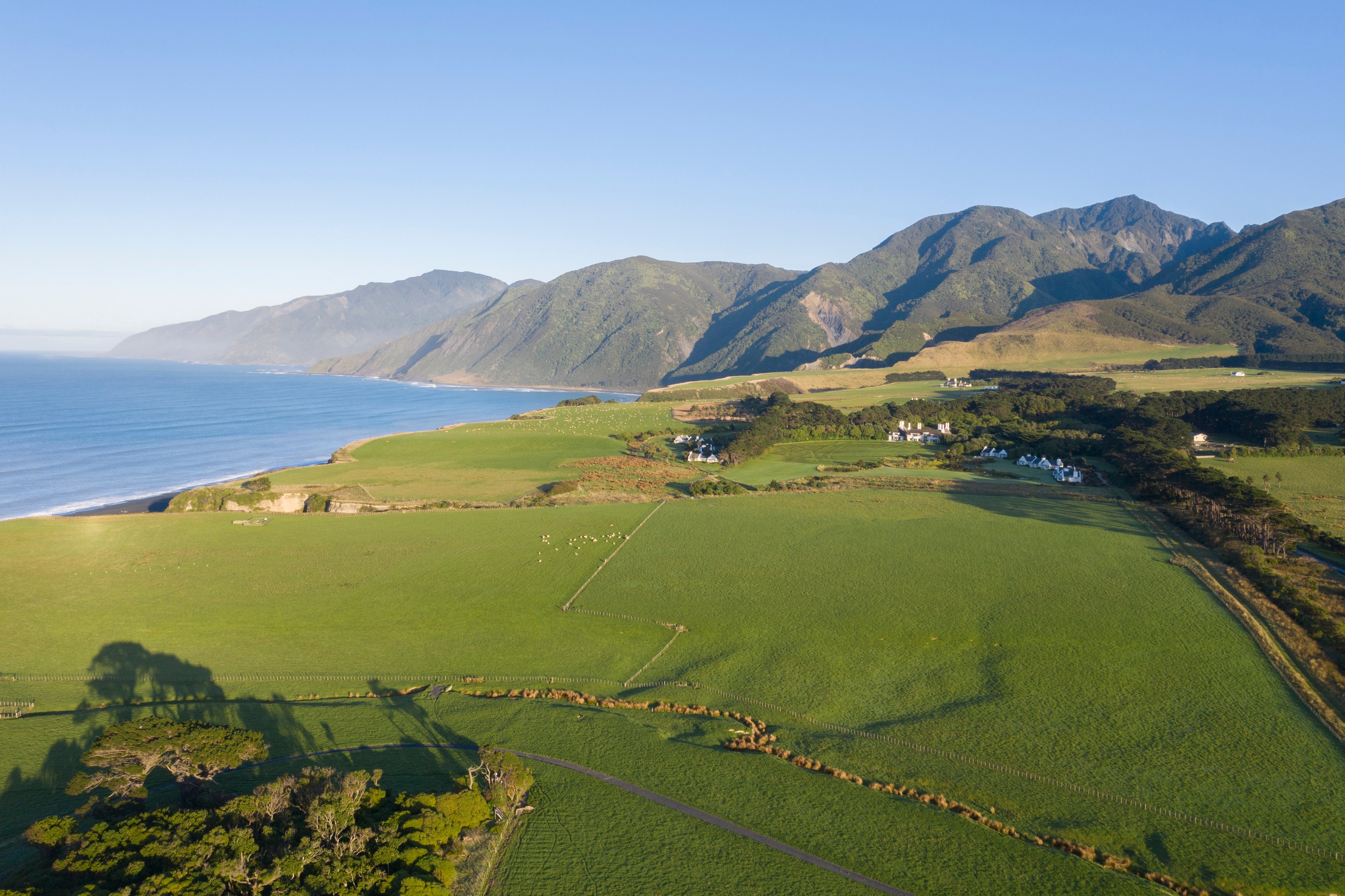
Wharekauhau Lodge, properly Wharekauhau Country Estate, is a luxury lodge on a working sheep farm, or station, above Palliser Bay in the Wairarapa, at the southern end of New Zealand's North Island. It sits on about 1,200 hectares (3,000 acres), 90 minutes by road from Wellington Airport, with sixteen cottage suites, a three-bedroom villa and an Edwardian-style lodge on the hill. Sheep have been farmed here since the 1840s, and the estate holds Two Michelin Keys. Here is what a stay there is like, and where it sits in a journey.
Wharekauhau at a glance
- Where. Palliser Bay, in the south of the Wairarapa, where the Remutaka Range meets the sea.
- Getting there. About 90 minutes by road from Wellington Airport, or 10 to 12 minutes by helicopter.
- Rooms. Sixteen Cottage Suites, and the Foley Villa for up to six.
- The land. About 1,200 hectares (3,000 acres) of pasture, native forest and coast, farmed with Romney sheep and Black Angus cattle.
- Owners. Bill and Carol Foley, since 2010.
- Recognition. Two Michelin Keys, one of ten New Zealand properties to hold them in the 2026 selection (our guide to Michelin Key lodges and hotels lists them all), and a member of Relais & Châteaux.
- How long. Two nights on our Discovery journey, with a day built around the station.
Where is Wharekauhau Lodge?
At the bottom of the North Island, where the Remutaka Range runs down to the sea. The estate runs down to the black-sand beaches of Palliser Bay, and the lodge sits high on the hillside, looking out over the ocean and the farm. Martinborough, the Wairarapa's wine village, is inland; Cape Palliser and the fishing village of Ngāwī are along the coast to the south-east. Our Wairarapa page describes the region around it.
How do you get to Wharekauhau?
By road, it is a 90-minute drive from Wellington Airport, over the Remutaka Range. By helicopter, it is about 10 to 12 minutes from Wellington along the south coast, landing on the lodge's front lawn. Guests arriving by private jet can be met airside and flown straight on. The lodge also arranges private drivers, and from Napier, in Hawke's Bay, the drive is about four hours.
What is the history of Wharekauhau?
The land was first cared for by Ngāti Kahungunu. Sheep have been farmed here since the 1840s, and the station became one of New Zealand's oldest Romney sheep studs. Its emblem, a rowlock, goes back to 1876, when wool went out across the bay by longboat and a ship's captain questioned the weight of the bales. The crew answered with a mark of their own, painted with a rowlock (an oarlock) from their longboat, and raced to register it in Wellington before the ship left New Zealand waters. The Shaw family, farming here from the late 1970s, began taking in travellers who wanted to see a station at work, and in time built the lodge and cottages for them.
Who owns Wharekauhau?
Bill and Carol Foley, since 2010. They came back to Wharekauhau while touring New Zealand's vineyards and made it their own. Their Foley Wines group includes Te Kairanga and Martinborough Vineyard, both in Martinborough, and Lighthouse Gin, which is made with spring water from the estate. That family connection runs through the wine days the lodge arranges.
What are the rooms like at Wharekauhau?
- Cottage Suites. Sixteen of them, each 70 square metres (753 sq ft) with one bedroom, set across the hillside no more than 150 metres (490ft) from the lodge. Each has a private terrace facing the ocean, an open gas fire, a double spa bath, heated marble floors, New Zealand wool carpets and hand-plastered walls. Suites can interconnect, for families and friends travelling together.
- Foley Villa. Three bedrooms over 418 square metres (4,500 sq ft), each with its own bathroom and claw-foot bath, a short walk from the lodge. A heated infinity pool, an outdoor fireplace, a kitchen where a private chef can cook, and direct helicopter access. For up to six, with exclusive use.
The lodge itself is where the day gathers, a house of antiques and big fireplaces, with a dining room, a country kitchen and a conservatory running one into the next and a courtyard garden through the French doors. The lodge calls itself a private estate rather than a traditional hotel.
What is the food like at Wharekauhau?
There is no restaurant in the usual sense. Guests eat in the Dining Room, as they would in a private house. Dinner begins with drinks and canapés by the fire, then a four-course seasonal menu, then petit fours, often back by the fire. There is a lighter farmhouse bistro menu for anyone who wants one, and breakfast is in the Country Kitchen, with house-made preserves.
Much of it comes from the estate or the coast below it. Seasonal dishes may draw on the estate's own lamb, wild black abalone (pāua), seaweed, native herbs and wild mushrooms, vegetables and orchard fruit from the gardens, eggs from the hens, wasabi and watercress grown in the estate's waterways, line-caught local fish and sea salt from the ocean. The cellar is built on Martinborough pinot noir and chardonnay, with back vintages not easily found elsewhere, and the sommelier leads tastings in it in the early evening.
From November to April, weather permitting, a chef cooks lunch out on the estate, in what the lodge calls Chef in the Wild.
What is included in a stay at Wharekauhau?
Every night includes pre-dinner drinks and canapés, a multi-course dinner and a full country breakfast the next morning. So do the lodge's own facilities, with no booking needed: the heated indoor saltwater pool, 22 metres (72ft) long, the gym, the hot tub, barrel sauna and ice bath of the Wellness Barn, tennis, croquet, and the walking and mountain-biking trails across the estate. Guided experiences and spa treatments are booked separately.
What can you do at Wharekauhau?
The farm. A four-wheel-drive tour leaves the lodge at 9:30am each day and takes about three hours: the Romney sheep and Black Angus cattle, the dogs working the flock, a shearing demonstration, and stops at lookouts across the estate. This is the day The Discovery is built around here.
The coast. Ride quad bikes (ATVs) with a guide for two hours across the black-sand beach, the riverbanks and the pasture, or take an e-bike along the coastal track to Muka Muka Bay with a picnic in your pack and, with luck, seals sunbathing on the rocks. There is beach fishing on the bay when tide and weather allow, clay-target shooting over a gorge above a stony stream bed, and archery.
Cape Palliser. A full day along the coast to Cape Palliser (Mātakitaki-a-Kupe), the North Island's southernmost point. The road passes Ngāwī, a fishing village with no harbour, where the boats are launched from the beach by bulldozer. The red-and-white striped lighthouse at the cape was first lit in 1897, and its 258 steps were built in 1912, with the South Island across the strait on a clear day. The cape is home to the North Island's largest fur seal breeding colony. Fish and chips on the way home at the Lake Ferry Hotel, established in 1851.
Martinborough. Inland, a village founded in 1879 by the landowner John Martin, who laid it out in the shape of a Union Jack and named its streets after people and places from his 1875 grand tour. Vines were first planted in the Wairarapa in 1883, the modern vineyards in the late 1970s, and since the 1980s Martinborough has been the capital of the region's wine. New Zealand Winegrowers, the industry body, compares its climate and soils with Burgundy's; the lodge points to its dry, stony soils and coastal breezes; and some cellar doors, the wineries' tasting rooms, are within walking distance of one another. The lodge arranges a guided tour with lunch, a self-guided e-bike day through the vines, a day of barrel tastings in private cellars, and a helicopter day to three Foley family vineyards: Te Kairanga in Martinborough, and Vavasour and Grove Mill in Marlborough. Our guide to New Zealand wine beyond sauvignon blanc sets Martinborough in context.
Further afield. A day among the makers of the South Wairarapa villages, an olive grove, a chocolatier, a honey producer and a lavender farm; golf at Royal Wellington, 10 minutes away by helicopter or about 70 minutes by road; or a private driver into the capital for a tour behind the scenes at Te Papa, the national museum. Our piece on Wellington in a day covers the city.
At night. A guided hour of stargazing with a local astronomer on your own terrace, under the Wairarapa's certified dark-sky reserve.
When is the best time to visit Wharekauhau?
Each season gives a different stay. The lodge's own figures: summer, December to March, runs 20 to 30°C (68 to 86°F), hot and dry with little wind. Autumn, April and May, is 10 to 18°C (50 to 64°F), crisp mornings and mild, dry afternoons. Winter, June to September, is 10 to 15°C (50 to 59°F), fires lit, and now and then a southerly storm coming in across the bay to watch from the warm side of the glass. Spring, October and November, is 15 to 24°C (59 to 75°F), with longer days and the gardens in blossom. Our guide to New Zealand weather by season covers the rest of the country.
Who is Wharekauhau right for?
Travellers who want a country house and a working farm in the same stay, with the farm close enough to watch rather than read about. Couples who want space: sixteen suites on about 1,200 hectares (3,000 acres). Families and small groups, for the interconnecting suites and the villa for six. Wine travellers, for Martinborough inland and a cellar built on it. On The Discovery it is the stop between Hawke's Bay and the South Island, for a guest happy to be 90 minutes from the city. If every evening needs to be in Wellington's restaurants, stay in the city and come out for the day.
How does Wharekauhau fit into a New Zealand journey?
The Discovery spends two nights here. It arrives from Rosewood Cape Kidnappers in Hawke's Bay through Martinborough, with a boutique winery lunch and tasting on the way, and builds the next day around the station: the four-wheel-drive tour, the shearing and the dogs. On the third day a private driver takes you to Wellington for a tour behind the scenes at Te Papa, the national museum, then flies south to Christchurch for Otahuna Lodge. Every journey is a starting point, and we shape it around you: more nights here, or Wharekauhau in a journey of your own, is a conversation with a curator.
Walk down to the black-sand beach on the first evening, with the lodge on the hill behind you. The station has been here since the 1840s, and from the sand it looks it.
Written by
The people who compose the journeys. By PPG Tours, named New Zealand’s Leading Destination Management Company at the World Travel Awards, 2025 and 2026. How we write
Journeys this piece touches
Places in this piece
Add Curated Experiences as a preferred source on Google (opens in a new tab)
More reading
Lodge Insider